
Gigpro → Qwick
Rebuilding trust in a staffing marketplace
Overview
In 2022, Gigpro, now Qwick, helped hospitality businesses fill open shifts by connecting them with independent Pros through an open-application marketplace. But as businesses encountered no-shows, inconsistent professionalism, and uneven skill levels, trust in the platform's talent quality began to erode.
The fulfillment flow
Business posts a gig → Pros apply → Business reviews applicants → Business sends offers → First Pro(s) to confirm secure the gig
Feedback from churned accounts made the issue clear: 45.5% of survey respondents cited insufficient training and professionalism as their primary reason for leaving, alongside concerns about reliability, vetting, and access to qualified talent.
| Issue | Count | Percentage |
|---|---|---|
| Pros not trained or professional | 10 | 45.5% |
| Not predictable level of quality | 5 | 22.7% |
| Walkouts and last-minute cancellations | 4 | 18.2% |
| Low confidence a Pro will show | 2 | 9.1% |
| Can't screen or train Pros | 1 | 4.5% |
A review of the business experience showed that the issue was not a lack of qualified applicants. Businesses lacked the information to confidently evaluate Pros, while Pros had few ways to demonstrate their expertise.
What I did
Strengthened Pro profiles (2022–23)
Redesigned Pro onboarding to set clearer expectations and capture the information businesses needed to confidently evaluate candidates. The new flow included an online orientation, assessment quiz, and guided questions about availability, work preferences, experience, skills, and certifications. I translated those inputs into clear, scannable signals on business-facing Pro profiles.
Incentivized and surfaced performance (2023–24)
Designed Pro Ranks and Skill Certifications, defining how Pros earned and displayed achievements and how businesses used them during candidate evaluation. Performance badges and position-specific certifications gave businesses clearer signals of proven reliability and relevant experience.
Evolved fulfillment from selection to matching (2023–26)
Reduced businesses' reliance on manual applicant review by progressively introducing tools to rehire trusted Pros, surface stronger matches, and proactively fill shifts with qualified, available talent once enough signals were built.
Impact highlights
- Strengthened quality controls: Onboarding and verification changes were associated with a 79% reduction in no-shows and a 28% reduction in late cancellations.
- Enabled more targeted selection: Within two months of launch, Direct Offers accounted for about 13% of paid gigs and had higher completion rates than shifts filled through the open pool: 94% versus 91% in May and 96% versus 92% in June.
- Built a foundation for smarter fulfillment: Structured onboarding data, business-facing profile signals, and verified credentials became core inputs for Match, the platform's algorithmic fulfillment model.
Setting the Bar
2022–23
The work began by defining a clearer baseline for who could represent the business. At Gigpro, workers were called “Pros,” but that positioning didn't reflect the range of experience on the platform.
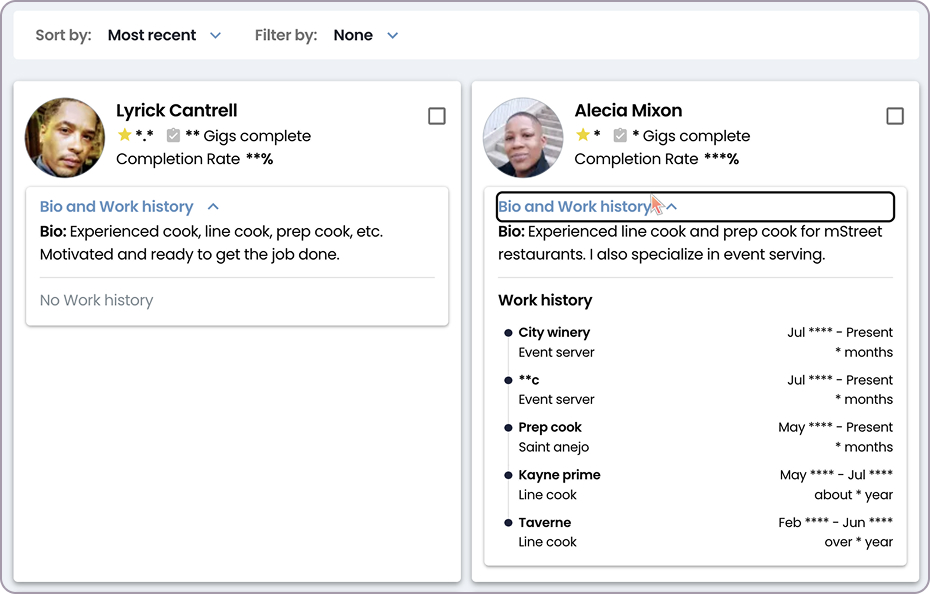
View of the Pro Profile Card (Before). Seasoned hospitality professionals sat side by side with those who had little to no background in hospitality.
“This last pro showed up 20 minutes late, didn't even introduce themselves upon walking in, and then just disappeared in the middle of service before their scheduled shift was over.”
After hearing recurring concerns from accounts about their experiences with Pros, I audited both the Pro onboarding flow and the connected business selection experience. The core question became: what does it mean to be a “Pro,” and how should the product uphold that standard?
The audit revealed a weak qualification baseline. Nearly anyone could join and apply for shifts, including Pros with little or no relevant hospitality experience. The only required profile fields were a short bio and photo, with little guidance on what a strong profile looked like. As a result, profiles were often incomplete, unclear, or unprofessional.
I redesigned onboarding to introduce intentional friction to raise the quality bar for applicants. To become eligible to apply for shifts, Pros had to complete a profile with their availability, work preferences, experience, and skills, then complete an online orientation and readiness assessment.
Pro Onboarding and Completed Profile in Pro Mobile App (Above)
These steps filtered out candidates unwilling to complete the preliminary requirements while collecting structured information from qualified Pros to create more complete, professional profiles for businesses to evaluate.
Structured onboarding inputs carried into the business-facing Pro selection card and Pro Profile, giving businesses richer, more consistent information to compare applicants, identify relevant experience, and select Pros with greater confidence.
Conveying Visual Trust Signals
2023–2024
Skill certifications
To give businesses stronger evidence of a Pro's capabilities before extending an offer, I designed the in-app experience for earning and displaying skill certifications, in partnership with the Pro Success team, who conducted the evaluations.
New Pros could be assessed during onboarding and earn multiple certifications based on their experience and aptitude. Existing Pros could also request an evaluation from Pro Success to earn certified badges.
These certifications gave businesses a clear signal that a Pro had been vetted for specific skills.
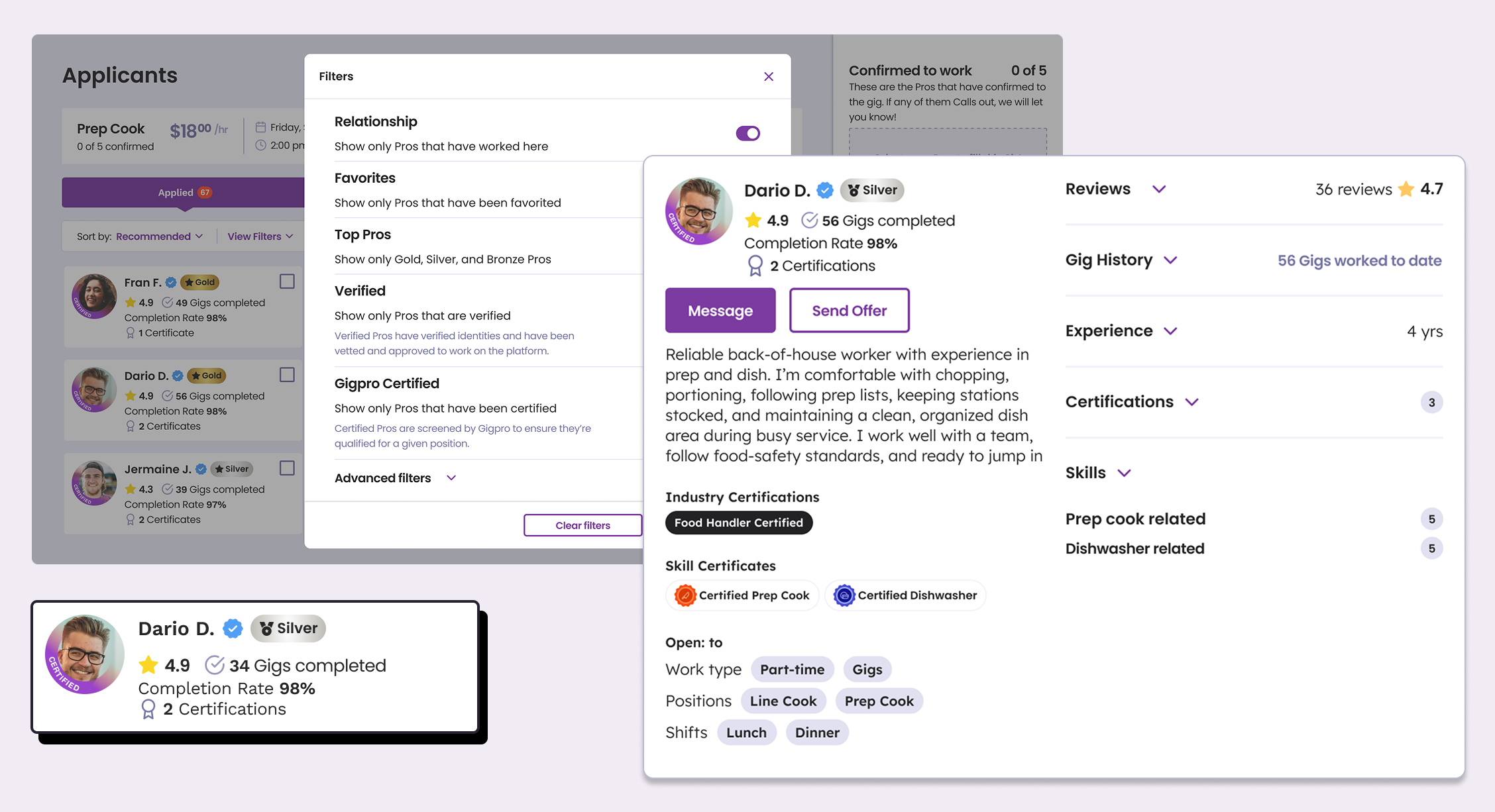
Badges appeared prominently on applicant cards and individual Pro profiles, helping businesses quickly identify qualified candidates and hire with greater confidence.
Pro ranks
Alongside certifications, I designed the in-app experience for Pro Ranks, a marketing-led recognition program that incentivized consistent, high-quality performance. Pros earned Bronze, Silver, and Gold status through shift volume, ratings, and a clean record, giving top performers a visible way to stand out in the applicant pool. The system made ongoing performance more tangible by recognizing the behaviors the platform wanted to reinforce.
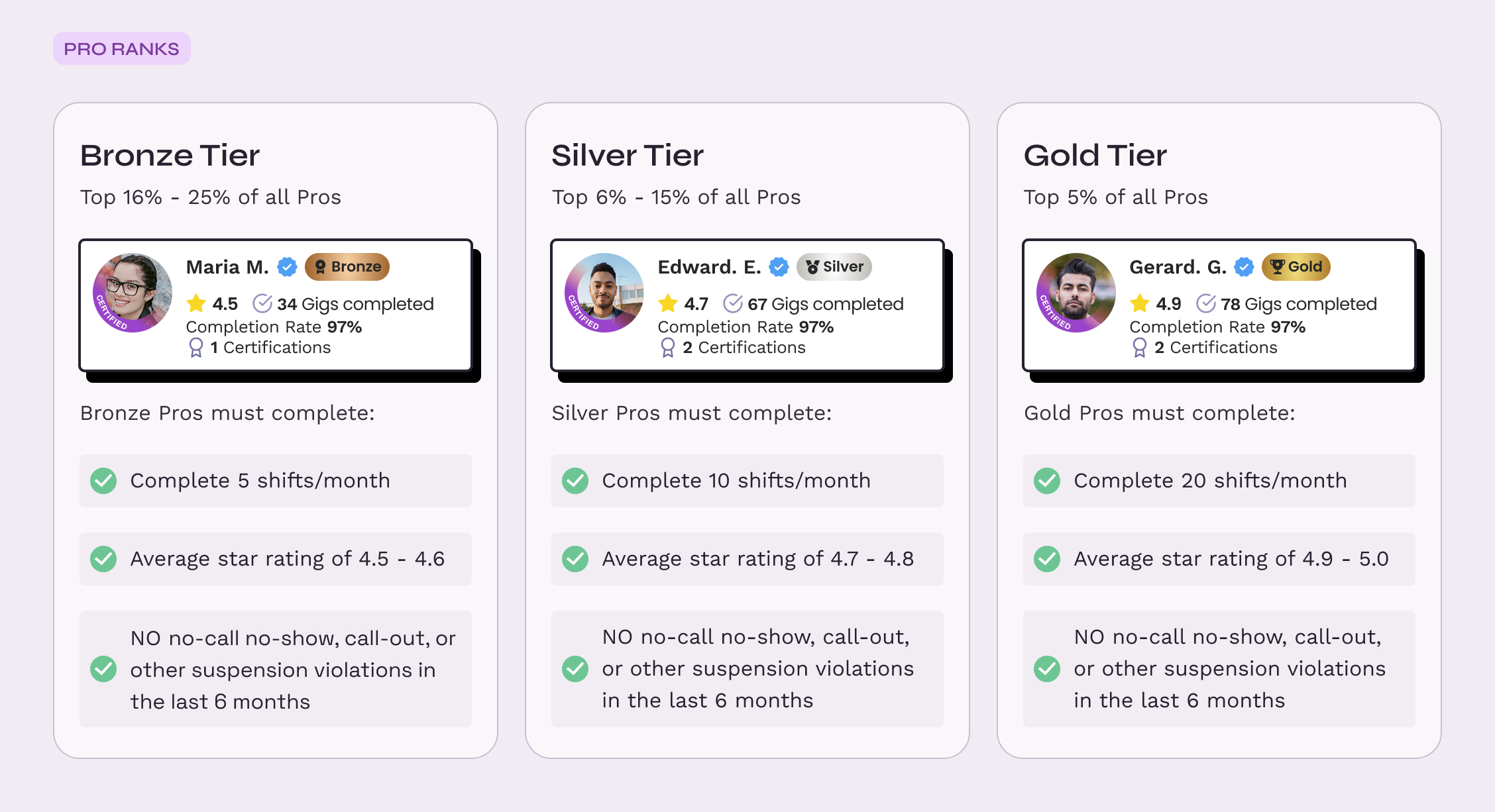
Bronze, Silver, and Gold tiers were earned through shift volume, rating thresholds, and a clean record, giving high performers a visible way to stand out in the applicant pool.
Industry certifications
Industry certifications enabled businesses to require industry certifications at the business, market, or gig level. This gave business operators greater control over who was eligible to apply. Pros could upload industry certifications which were then reviewed by admins; if they didn't have required certifications, they could access state-specific food and alcohol certification through the app.
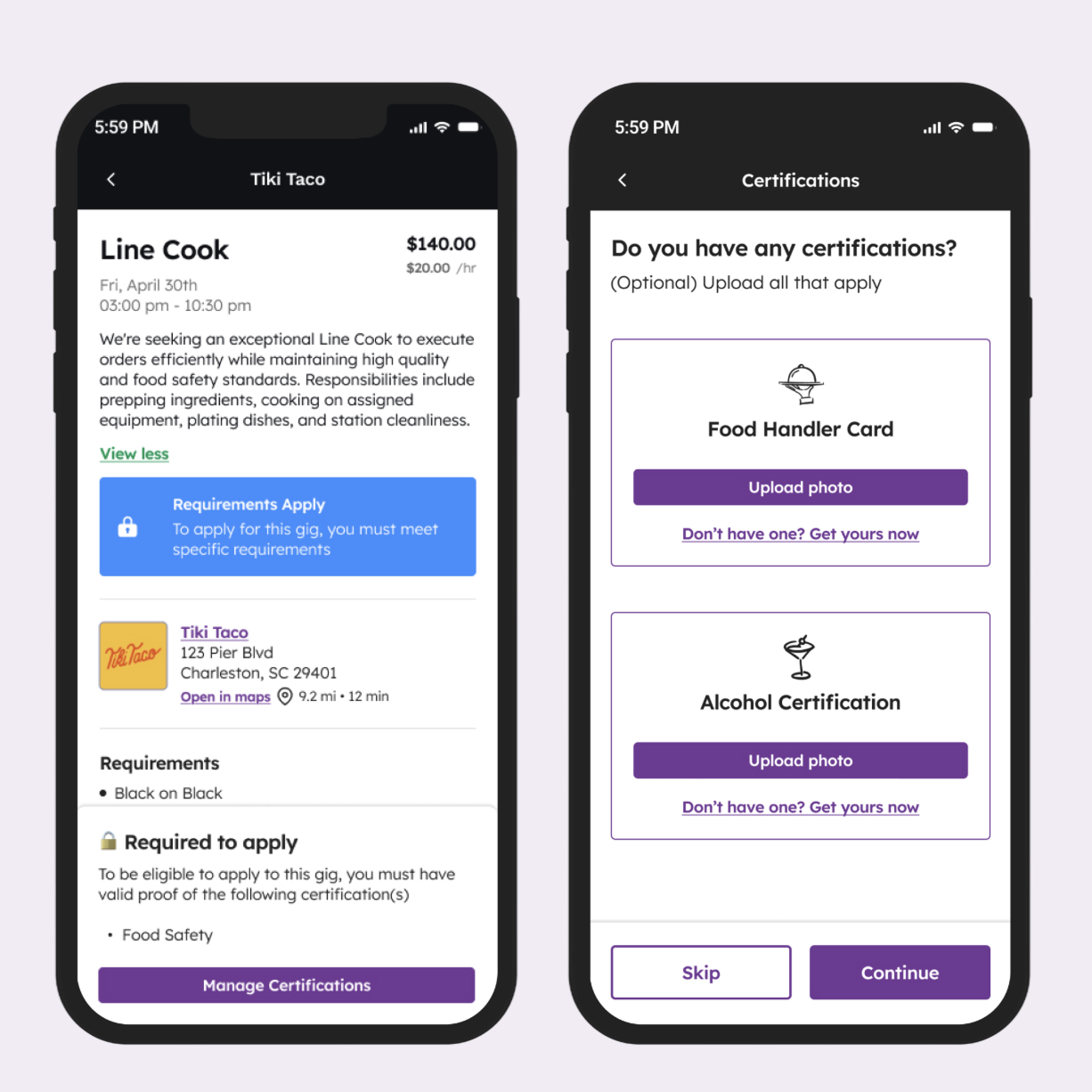
Posted Gig detail with required industry certifications on the Pro app.
Building a Path Towards Smarter Fulfillment
2024–26
Strengthening onboarding, profile data, and earned trust signals gave Gigpro and businesses a more complete view of each Pro, while establishing a clearer platform standard.
Structured data connected signals across experience, skills, availability, and performance, helping businesses make more confident hiring decisions. It also created the foundation for more intentional fulfillment models, beginning with a simple but important need: helping businesses reconnect with Pros they already knew and trusted.
Supporting business-led fulfillment
The first step was enabling businesses to act on relationships and preferences they had already built. At the time, the app offered no way to support that. After a shift ended, businesses could not contact a Pro again. Chats between Pros and managers were limited to the shift window to protect both parties, so when posting a new gig, businesses had to just hope a Pro they had proven success with would apply and confirm before anyone else.
Connect gave businesses a dedicated space to find, save, and organize Pros they had worked with. Businesses could browse Pros in the market by position and then refine results with available filters.
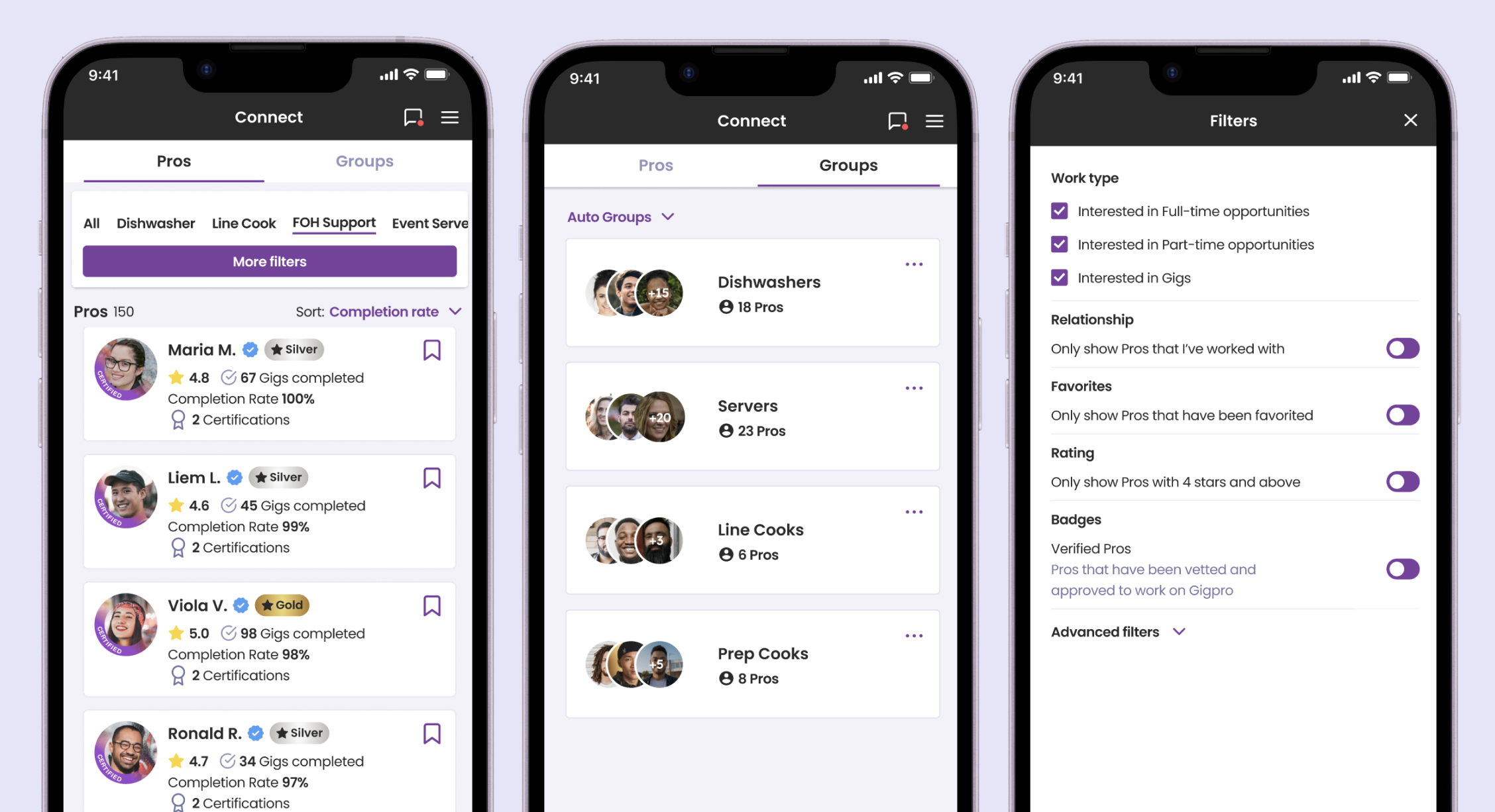
Connect view on Business mobile web
Direct Offers enabled businesses to post shifts to their Preferred Network rather than the default marketplace. When creating a shift, operators could choose which individual Pros or groups could access it. The first Pros to confirm were added to the roster. On the Pro side there was no need to apply and then wait for these offers, they could simply hit confirm upon receipt and have it added to their schedule.
Businesses could post gigs directly to the preferred network of Pros
Introducing data-informed selections
As profile data, certifications, and rank became reliable signals, I designed Recommended Pros, a ranked shortlist surfaced above the general applicant pool, ordered by fit signals like completion rate, rank, and relevant certifications, so operators could act fast without reviewing every applicant manually.
Recommended Pros was designed as an “easy button” for selection: a shortlist above the general applicant pool that surfaced the strongest fits for each shift. Businesses could choose individual Pros to receive an offer or use Send offers to all to instantly reach every recommended Pro.
Steps towards automation
Automatch let Gigpro test a platform-led fulfillment model while preserving business oversight. Businesses could continue selecting candidates from the pool as they always had, but if they did not make enough selections or forgot to select anyone, Automatch kicked in and sent offers to matched Pros to ensure the shift was filled.
Early results indicated that platform-selected Pros had higher completion rates and stronger business ratings than manually selected Pros.
Platform-led fulfillment
The work leading up to Match set the foundation for Gigpro's evolution from an open marketplace to a more active matching and fulfillment platform. By setting clearer standards for Pros, improving onboarding, and strengthening profiles, we had a better understanding of each Pro's experience, qualifications, and readiness.
Direct Offers, Recommended Pros, and Automatch helped us put those signals to work, first by helping businesses build trusted networks and make more informed selections, then by testing how the platform could play a larger role in fulfillment.
By mid 2025 and early 2026, following Gigpro's merger with Qwick, those efforts came together as Match. Businesses no longer had to spend time sorting through applicants (unless they wanted to), and Pros were no longer feeling as though they were shouting into the void.
Pros went from applying to confirming. With Match, qualified Pros could skip the uncertainty of applying and waiting to be selected. Instead, they could see shifts they were matched to, accept them instantly, and add them directly to their schedule.
Businesses could trust Match to fulfill shifts while retaining the option to review selections, remove Pros, or send direct offers.
Reflection
Trust was not restored through one feature. It was earned through a series of connected improvements that gave businesses and Pros clearer expectations, more reliable information, and better outcomes. Each release built on the last, giving businesses another reason to rely on the platform.
Feedback from businesses and Pros shaped stronger onboarding, profiles, certifications, and performance history, giving businesses a more reliable view of each Pro's experience and readiness. Those signals then powered trusted networks, guided recommendations, and eventually automated fulfillment, creating a lower-risk path from manual selection to platform-led matching while preserving business oversight.
The result was a more reliable marketplace for both sides. Businesses spent less time sorting through applicants and had greater confidence in who was selected, while qualified Pros had clearer opportunities to stand out and get matched to shifts.
Next case study
Scaling design through growth and acquisition →